
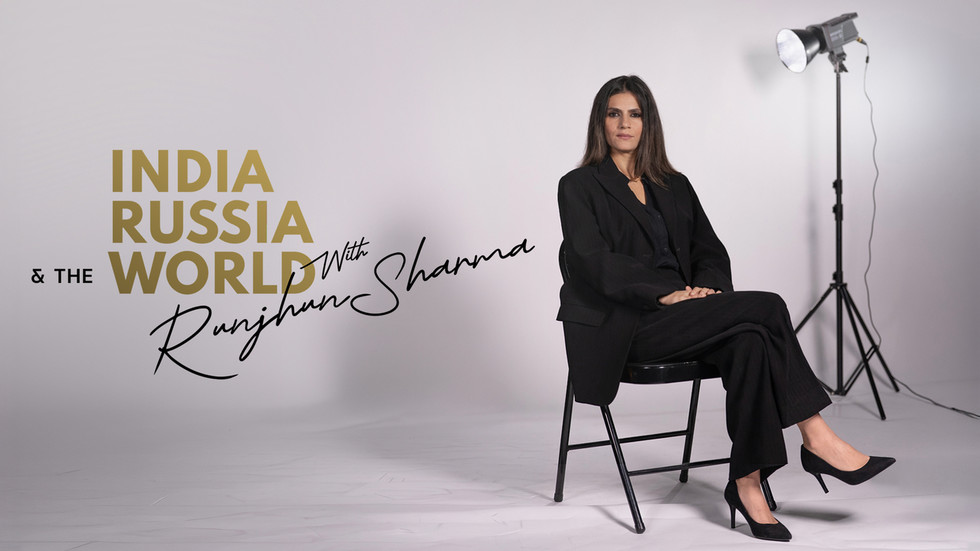
A weekly podcast and a deep dive into the most pressing global issues through the lens of India and Russia. Two civilizational powers. The world’s largest democracy, India, and the world’s largest nation, Russia – like chess pieces navigating a shifting global board. Hosted by Runjhun Sharma, head of news at RT India, the show draws on her years of covering foreign policy from New Delhi, Moscow, and beyond.
Conversation with Seyed Mohammad Marandi and Sanjiv Arora, former Indian Ambassador to Lebanon and Qatar
In this episode of India, Russia and the World, we look at the US-Iran crisis through two distinct lenses. First, Seyed Mohammad Marandi, a political analyst and professor at the University of Tehran, unpacks the Iran ceasefire, calling it “a catastrophic defeat for the United States.” Marandi asserts that Iran remains firmly in control of the Strait of Hormuz, with its armed forces prepared to resume the war if negotiations are used as a cover for rearmament or deception. We also speak to Sanjiv Arora, former Indian ambassador to Lebanon and Qatar, who brings in the Indian perspective, explaining what developments around Iran mean for India’s energy security and its efforts to diversify oil supplies.
Conversation with Shia cleric Aga Syed Ruhullah Mehdi
In this episode on India, Russia and the World, Kashmiri member of the Indian parliament and Shia cleric Aga Syed Ruhullah Mehdi explains the reasons for the deep connection Kashmiri Muslims share with Iran. He holds the British responsible for creating the political divide between Shia and Sunni Muslims in the Gulf nations. He calls out the West for looking at Muslims only through the narrow lens of their women’s clothes and terrorist outfits like the Al-Qaeda and ISIS, and using that as a pretext for demonizing them.
Conversation with Suhasini Haidar, diplomatic editor for The Hindu
In this episode, Suhasini Haidar, the diplomatic editor of The Hindu, highlights how America’s reading of the mindset of Iranians has been its biggest miscalculation. She emphasizes that India has always stood for strong bilateral ties with all nations in the Middle East, but it must secure its food, fuel, and fertilizer security. She stresses the fact that the US, which had always underpinned the global rules-based order, is now its biggest violator.
Defense Expert Deepika Saraswat on US-Israeli war against Iran
In this episode, Deepika Saraswat, an associate fellow at the West Asia Center, Manohar Parrikar Institute for Defense Studies and Analyses, highlights how the killing of Supreme Leader Ayatollah Ali Khamenei has hardened public sentiment against Israel and the US. She says Iran seems to have always expected these attacks to happen, and they have a strategy in place – which is to make the whole world, not just the region, bear the economic toll of this war.
‘India is the future, the West is the past’ – Russian ambassador
In this episode of ‘India, Russia and The World with Runjhun Sharma’, Denis Alipov, the Russian ambassador to India, emphasizes that India-Russia ties are a stabilizing factor in Eurasia – for peace and common security. On the current developments in the Middle East, he says that it’s a blatant violation of international laws and that Russia calls for a cessation of hostilities. The crisis also shows that Russian oil can’t be excluded from the global oil basket.
US acts with typical Western colonial mindset, thinks it can kill with impunity – Iranian supreme leader’s representative in India
In this episode, Abdul Majeed Hakeem Ilahi, the special representative of Iran’s supreme leader in India, offers the Iranian perspective to the killing of Ayatollah Ali Khamenei. He says the US, like a typical western colonial power, thinks it has the right to kill anyone. He claims that it is not the US and Israel that are waging war against Iran – it is the private war of Donald Trump and Benjamin Netanyahu.